If you want to know what God desires, start smaller than the stage.
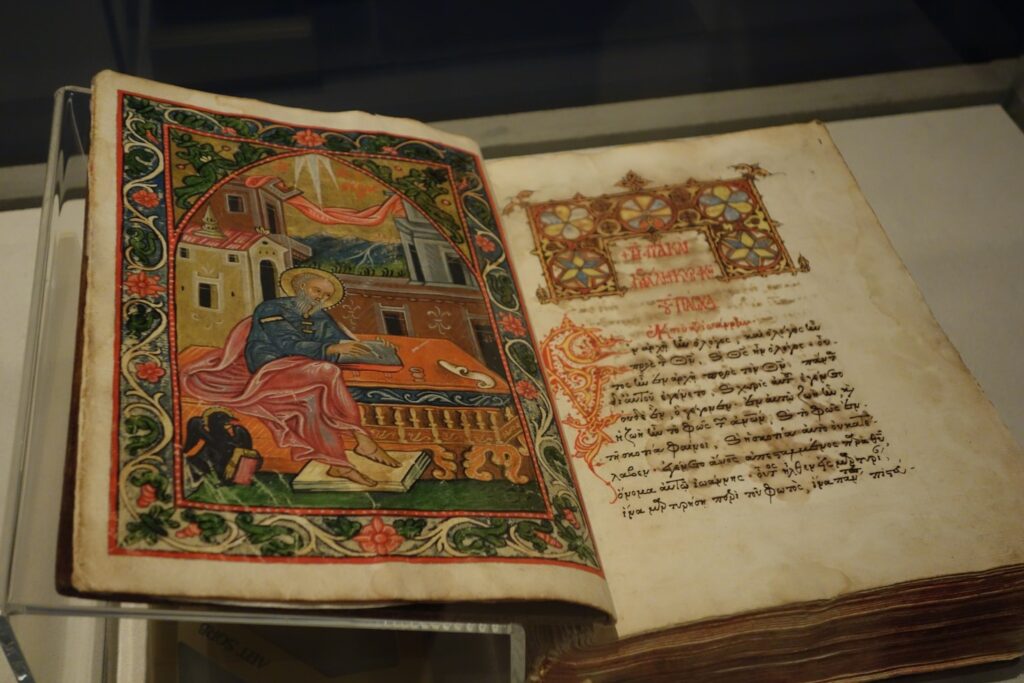
The Didache—“The Teaching of the Lord through the Twelve Apostles to the Nations”—is one of the earliest Christian manuals we still have. It likely took shape in the late first or early second century. It is not Scripture, and it should not be treated as Scripture. It is something almost as useful for a confused age: a short record of how communities formed people before Christianity had cathedrals, brands, broadcast empires, or professional religious celebrities.
That is why it is a good first step. Not because antiquity is magic. Because it is close to the ground.
God’s desire, as the first teachers actually named it
The Didache does not begin with a campus map, a giving campaign, or a personality. It begins with a choice:
There are two ways, one of life and one of death, and there is a great difference between the two ways.
The way of life is this: first, you shall love the God who made you; second, your neighbor as yourself. And whatever you would not have done to you, do not do to another.
That is the center. Love the Maker. Love the neighbor. Refuse to do to another what you refuse for yourself. Then live it in the details Jesus already taught: bless those who curse you, pray for enemies, give, tell the truth, flee anger and lust before they ripen into damage, confess in the assembly, do not come to prayer with a dirty conscience.
You can spend a lifetime decorating that sentence. You do not need a lighting rig to understand it.
Massive churches and televangelism are not automatically false. Some large congregations preach Christ and feed the poor. The problem is not square footage. The problem is when human input—charisma, production, politics, merchandise, the hunger to be seen—crowds out the desire of God named in those first lines. Opulence is not the same thing as glory. One is gold leaf on a set. The other is a life that looks like the Way of Life.
A faith that could be practiced without an industry
Look at what the Didache thinks a church needs.
Water. Baptize in the name of the Father and of the Son and of the Holy Spirit. Prefer running water. If you do not have it, use other water. If you cannot immerse, pour three times on the head. Fast first if you can. No font catalog. No debate that postpones obedience.
A prayer Jesus already gave. Pray the Lord’s Prayer three times a day. Fast on Wednesday and Friday, not in order to perform holiness on the same schedule as “the hypocrites.”
A table. Short thanksgivings over a cup and broken bread. Only the baptized eat. After the meal: “May grace come and may this world pass away.” Maranatha. No ticketed experience. No fog machine required for the Spirit to be present.
A household. Teach children the fear of God. Do not rule servants in bitterness. Share with the brother in want. “If ye are fellow-partakers in that which is imperishable, how much rather in the things which are perishable?”
A gathering. Meet often. Confess. Break bread. Appoint quiet, proven leaders who are not lovers of money.
None of this forbids beauty. It forbids dependency on beauty. God’s desire, in this document, is a people who can follow Him in a rented room, a river, or a kitchen.
The Didache already knew the televangelist problem
The most contemporary pages in the book are the ones about traveling teachers.
Receive the one who teaches the things already said. If he teaches another doctrine to destroy that teaching, do not hear him. Receive an apostle as the Lord—but he stays a day, two if needed. Three days, and he is a false prophet. When he leaves, give him bread until he finds shelter. If he asks for money, he is a false prophet.
Speaking “in the Spirit” is not proof. “Not every one that speaketh in the Spirit is a prophet, but only if he have the ways of the Lord. From his ways therefore the false prophet and the prophet shall be recognized.”
That is a first-century filter for a twenty-first-century industry.
A man can weep on camera, quote a verse, promise a harvest, and still be asking for money as the point of the visit. A woman can build a personal brand on “anointing” while the Way of Life—enemy-love, sexual integrity, truth-telling, care for the poor—never governs the books. The Didache does not say, “Check their follower count.” It says, watch how they live, how long they stay, and whether the gift flows toward them or through them.
God’s desire is not that nobody ever receive support. Paul argued for the opposite in another context. The Didache’s warning is narrower and blunter: spiritual speech plus a request for cash is already a disqualifying pattern. That single rule would empty a surprising number of mailing lists.
Human input is not the same as tradition
“Human input” is not a slur against all development. Christians after the apostles had to settle language about Christ, organize care for widows, and resist real heresies. Buildings can shelter the poor. Music can tell the truth. A large church can hide a thousand quiet acts of mercy.
Human input becomes a rival when it replaces the first teaching:
- When the preacher’s biography is the gospel.
- When giving is sold as a transaction with God.
- When worship is a show you attend rather than a life you walk.
- When the poor are a backdrop for the brand.
- When anger, lust, greed, and double speech are tolerated in leaders because the numbers work.
- When you cannot imagine following Jesus unless someone professionalizes the experience.
The Didache is useful here because it is pre-opulent. It has no incentive to protect a platform. Its teachers are dangerous if they linger and expensive if they collect. Its sacraments are portable. Its ethics are ordinary and severe. That combination is a solvent for religious theater.
Why it is a first step, not the last word
Do not romanticize the text. It is incomplete. It is not the Gospel of John. It will not answer every doctrinal question. It assumes the message of Jesus rather than unfolding it. Some of its household language belongs to the first-century world and must be read with the rest of Scripture. Treating it as a complete Bible would be another kind of human shortcut.
Use it as a first step the way the old communities used it: as a clearing of the ground.
Start here.
Can you name the two ways without a slogan?
Can you love the God who made you when no one is filming?
Can you love the neighbor who cannot advance you?
Can you pray the words Jesus gave without a soundtrack?
Can you tell a teacher by his ways rather than his reach?
Can you confess, give, fast, and keep watch for the Lord without being entertained into it?
If the answer is yes, you are already closer to God’s desire than a great deal of expensive religion. If the answer is no, the Didache is still a mercy. It does not ask you to join a machine. It asks you to change roads.
The Way of Life is not anti-church. It is anti-counterfeit. Massive churches and televangelists often sell access, certainty, and glow. The oldest Christian handbook we have outside the New Testament sells none of that. It offers a path, a table, water, a prayer, a warning about men who stay too long and ask for gold, and a last word that still undoes a studio: May grace come and may this world pass away.
That is a first step worth taking. The rest—buildings, cameras, crowds—can wait until the way itself is no longer for sale.